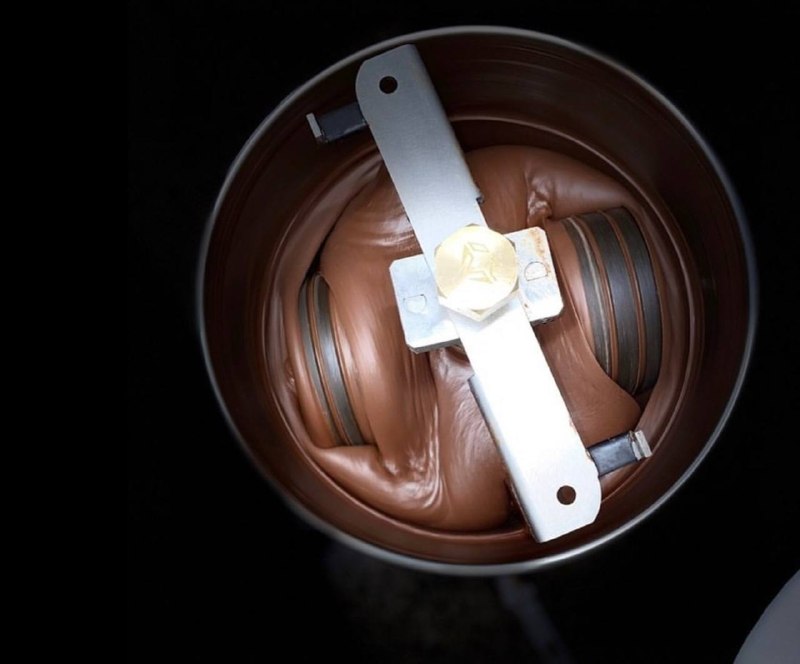

Melanger lids — protection, ventilation and conching
Does a melanger need a lid?
"Why?"—perhaps one of a true engineer's favorite questions.
You may have noticed that some household and professional melangers come with lids—either plastic or metal. But are they really necessary?
Let's take a look at what the cover is used for and whether it actually serves any purpose.
1. Safety
One of the arguments in favor of the cover is that it protects the operator from coming into contact with moving parts.
In European Union countries, manufacturing equipment must meet certain safety requirements in order to obtain CE marking. The presence of safety features may be one such requirement.
It’s true that the lid makes it difficult to reach the rotating grinding discs with your hands. But it cannot completely eliminate the risk of injury: for example, the rotating bowl remains exposed.
Therefore, safety depends not only on the design of the equipment, but also on compliance with operating procedures.
2. Protection against foreign objects
The lid can prevent dust and foreign objects from getting into the chocolate. But there’s a catch: many lids have cutouts for scrapers, through which things can still get inside.
In addition, since the lid has to be removed when adding ingredients, it does not protect the mixture during all stages of the process.
3. Dust Protection
But here, the lid is actually useful.
Even in a clean production facility, it is difficult to completely eliminate dust. During prolonged chocolate grinding, the cover helps reduce the amount of foreign particles that enter the mixture.
4. Effect on curing
And that is, perhaps, the most interesting point.
During conching, volatile acids and undesirable aromatic compounds are removed from the chocolate mass. This results in a more balanced flavor and allows the subtle aromas of cocoa to come through more clearly.
If the container is closed, the evaporation of volatile substances may be slowed. Therefore, the lid’s design should not interfere with natural air exchange during curing.
So, does a melanger need a lid?
There is no single answer. It all depends on the equipment's design, production conditions, and the operator's tasks.
The lid should protect the product without interfering with the processing of the chocolate mass. It is important that the operator be able to freely monitor the process, observe the rotation of the rollers, measure the temperature, and adjust it as needed.
At the same time, ease of use and safety must be taken into account as early as the equipment design phase, rather than being addressed simply by removing safety features.
The ideal lid is one that helps you work, rather than complicating the process.
Finding such an engineering solution remains an interesting challenge for melanger manufacturers.